VTracer

Raster to Vector Graphics Converter

Article | Web App | Download

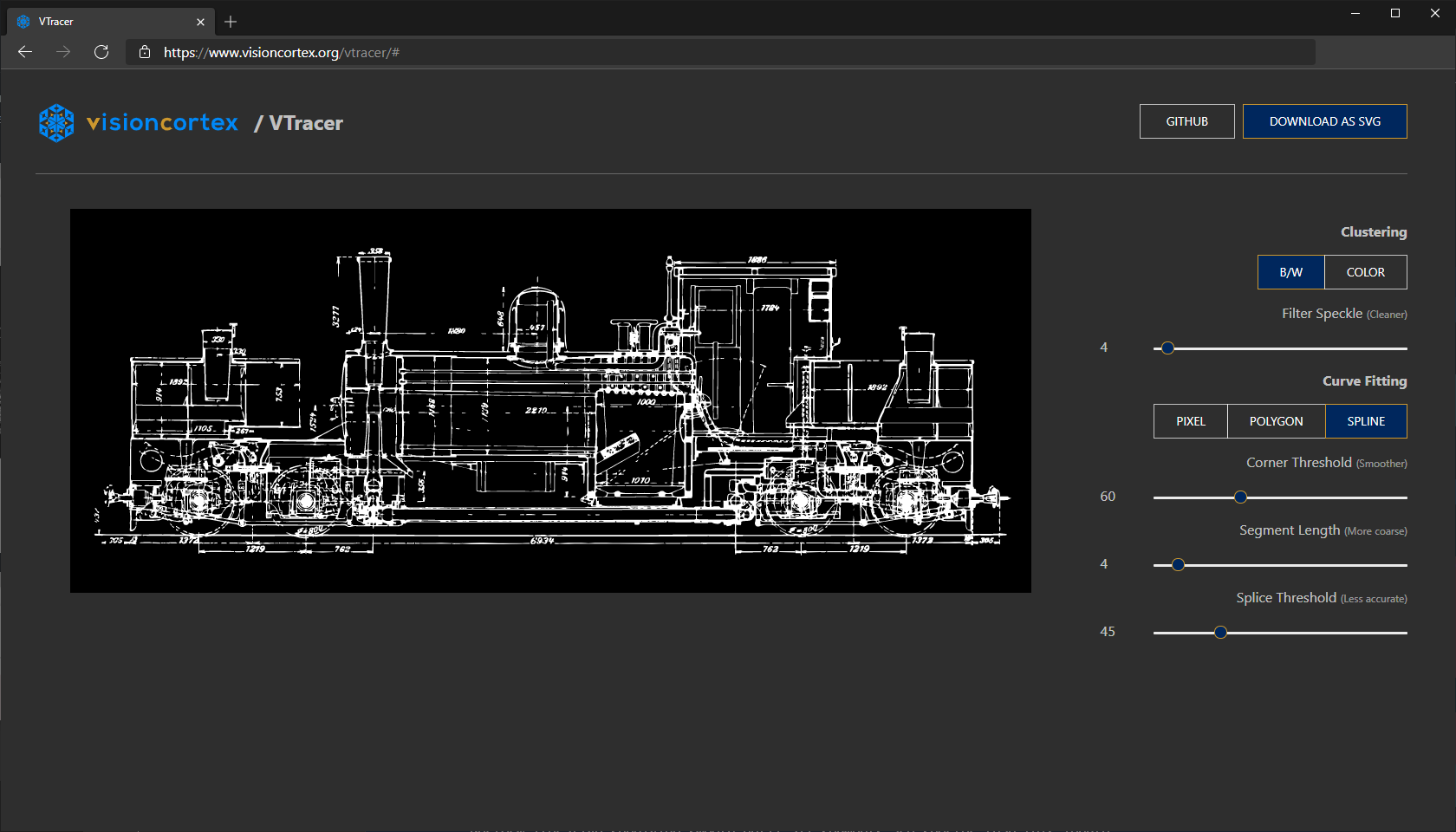
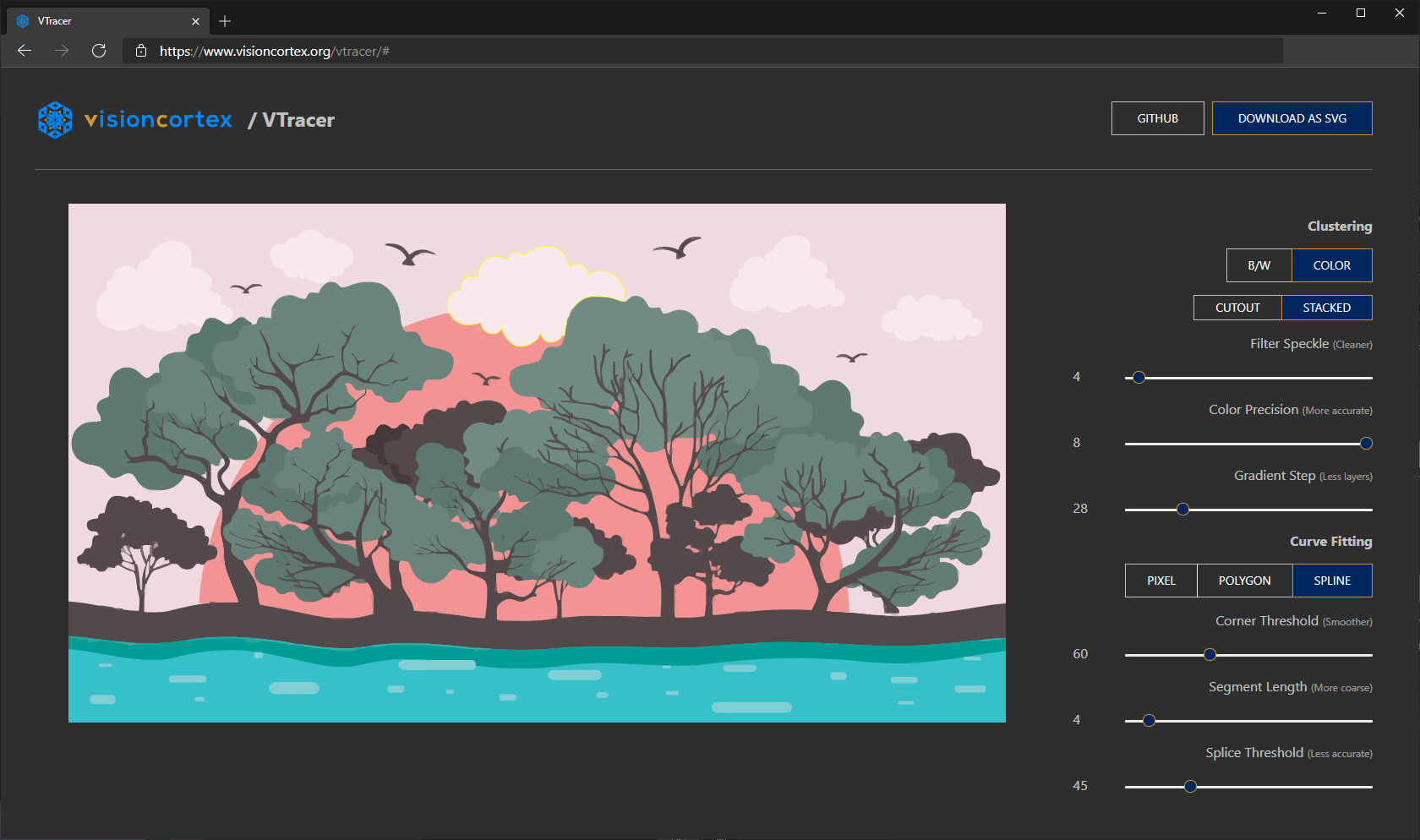
## Introduction visioncortex VTracer is an open source software to convert raster images (like jpg & png) into vector graphics (svg). It can vectorize graphics and photographs and trace the curves to output compact vector files. Comparing to [Potrace](http://potrace.sourceforge.net/) which only accept binarized inputs (Black & White pixmap), VTracer has an image processing pipeline which can handle colored high resolution scans. tl;dr: Potrace uses a `O(n^2)` fitting algorithm, whereas `vtracer` is entirely `O(n)`. Comparing to Adobe Illustrator's [Image Trace](https://helpx.adobe.com/illustrator/using/image-trace.html), VTracer's output is much more compact (less shapes) as we adopt a stacking strategy and avoid producing shapes with holes. VTracer is originally designed for processing high resolution scans of historic blueprints up to gigapixels. At the same time, VTracer can also handle low resolution pixel art, simulating `image-rendering: pixelated` for retro game artworks. Technical descriptions of the [tracing algorithm](https://www.visioncortex.org/vtracer-docs) and [clustering algorithm](https://www.visioncortex.org/impression-docs). ## Desktop App (coming soon) ![screenshot](docs/images/screenshot-01.png) ![screenshot](docs/images/screenshot-02.png) ## Cmd App Input and output can be given as positional arguments or as named flags: ```sh vtracer input.jpg output.svg # equivalent to: vtracer --input input.jpg --output output.svg ``` Full options (flag names are kebab-case, e.g. `--filter-speckle`): ```sh Usage: vtracer [OPTIONS] [INPUT] [OUTPUT] Arguments: [INPUT] Input raster image (positional; or use --input) [OUTPUT] Output SVG (positional; or use --output) Options: -i, --input Path to the input raster image -o, --output Path to the output SVG --preset Start from a preset: bw, poster, photo --colormode Color image `color` (default) or binary image `bw` --hierarchical Clustering: `stacked` (default) or `cutout` (seam-free mosaic) -m, --mode Curve-fitting mode: `pixel`, `polygon`, `spline` -f, --filter-speckle Discard patches smaller than X px in size (0..=128) -p, --color-precision Significant bits per RGB channel (1..=8) -g, --gradient-step Color difference between gradient layers (0..=255) -c, --corner-threshold Minimum momentary angle (degrees) to be a corner (0..=180) -l, --segment-length Subdivide until all segments are shorter than this (3.5..=10) -s, --splice-threshold Minimum angle displacement (degrees) to splice a spline (0..=180) --path-precision Decimal places to use in path coordinates --palette Fixed palette: comma-separated hex colors, e.g. '#112233,#445566' --palette-file Fixed palette from a file (hex colors, comma/newline separated) --max-colors Auto-quantize to at most N colors --optimize Output optimization: 0 = off, 1 = quantize+simplify, 2 = + shorthands -h, --help Print help -V, --version Print version ``` ### New in 1.0 - **Positional arguments** — `vtracer in.png out.svg`. - **`--hierarchical cutout`** is now a true seam-free mosaic (a gapless tessellation with shared boundaries), replacing the old re-clustered cutout. - **`--palette` / `--palette-file`** — snap colors to a fixed palette (nearest in OKLab); **`--max-colors`** auto-quantizes the palette. - **`--optimize`** — output size passes (coordinate quantization, redundant- point removal, relative/shorthand path encoding). ## Downloads You can download pre-built binaries from [Releases](https://github.com/visioncortex/vtracer/releases). You can also install the program from source from [crates.io/vtracer](https://crates.io/crates/vtracer): ```sh cargo install vtracer-cli ``` > You are strongly advised to not download from any other third-party sources ### Usage ```sh # simplest form ./vtracer input.jpg output.svg # black & white line art ./vtracer input.jpg output.svg --preset bw # seam-free mosaic (gapless tessellation) ./vtracer input.jpg output.svg --hierarchical cutout # constrain to a fixed palette ./vtracer input.jpg output.svg --palette '#1b1b1b,#e0c088,#5a7d3c,#8fb0d0' ``` ### Rust Library You can install [`vtracer`](https://crates.io/crates/vtracer) as a Rust library. ```sh cargo add vtracer ``` ### Python Library [`vtracer`](https://pypi.org/project/vtracer/) is also packaged as a Python native extension (built with [pyo3](https://github.com/PyO3/pyo3) + [maturin](https://www.maturin.rs), from the `crates/vtracer-py` crate). ```sh pip install vtracer ``` ```python import vtracer # one-liners vtracer.convert_file("in.png", "out.svg") svg = vtracer.convert_bytes(open("in.png", "rb").read()) # rich, reusable config + presets cfg = vtracer.Config(mode="polygon", hierarchical="cutout") cfg.palette = ["#1b1b1b", "#e0c088", "#5a7d3c"] svg = cfg.convert_bytes(data) vtracer.Config.poster().convert_file("photo.jpg", "poster.svg") ``` See [`crates/vtracer-py`](crates/vtracer-py/README.md) for the full API. ### Node.js Library [`@visioncortex/vtracer`](https://www.npmjs.com/package/@visioncortex/vtracer) is available for Node as a WebAssembly build (from the [`nodejs`](nodejs/README.md) package) — image decoding and vectorization both run in wasm, so there is **no native dependency**. ```sh npm install @visioncortex/vtracer ``` ```js const vtracer = require('@visioncortex/vtracer'); await vtracer.convertFile('in.png', 'out.svg', { mode: 'polygon' }); const svg = vtracer.convertBuffer(buffer, { preset: 'poster' }); const svg2 = vtracer.convertPixels(rgba, width, height, { colorMode: 'bw' }); ``` ## Citations VTracer has since been cited by a few academic papers in computer graphics / vision research. Please kindly let us know if you have cited our work: + SKILL 2023 [Framework to Vectorize Digital Artworks for Physical Fabrication based on Geometric Stylization Techniques](https://www.researchgate.net/publication/374448489_Framework_to_Vectorize_Digital_Artworks_for_Physical_Fabrication_based_on_Geometric_Stylization_Techniques) + arXiv 2023 [Image Vectorization: a Review](https://arxiv.org/abs/2306.06441) + arXiv 2023 [StarVector: Generating Scalable Vector Graphics Code from Images](https://arxiv.org/abs/2312.11556) + arXiv 2024 [Text-Based Reasoning About Vector Graphics](https://arxiv.org/abs/2404.06479) + arXiv 2024 [Delving into LLMs' visual understanding ability using SVG to bridge image and text](https://openreview.net/pdf?id=pwlm6Po61I)