 Jokob-sk
📚 Docs for individual plugins
Script based plugins
- website_monitor (WEBMON)
- dhcp_servers (DHCPSRVS)
- dhcp_leases (DHCPLSS)
- unifi_import (UNFIMP)
- snmp_discovery (SNMPDSC)
- undiscoverables (UNDIS)
SQL query based plugins
template based plugins
🌟 Create a custom plugin: Overview
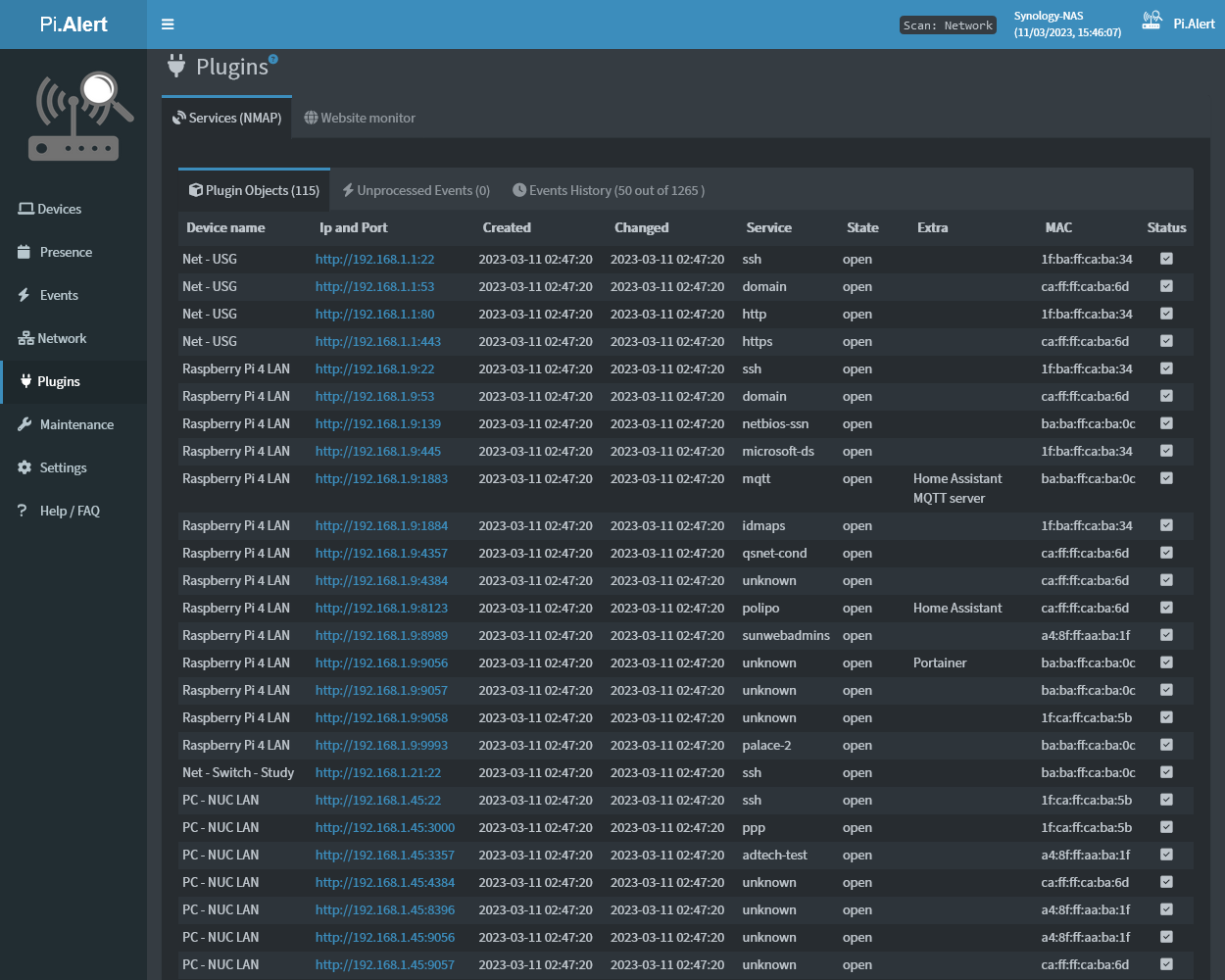 |
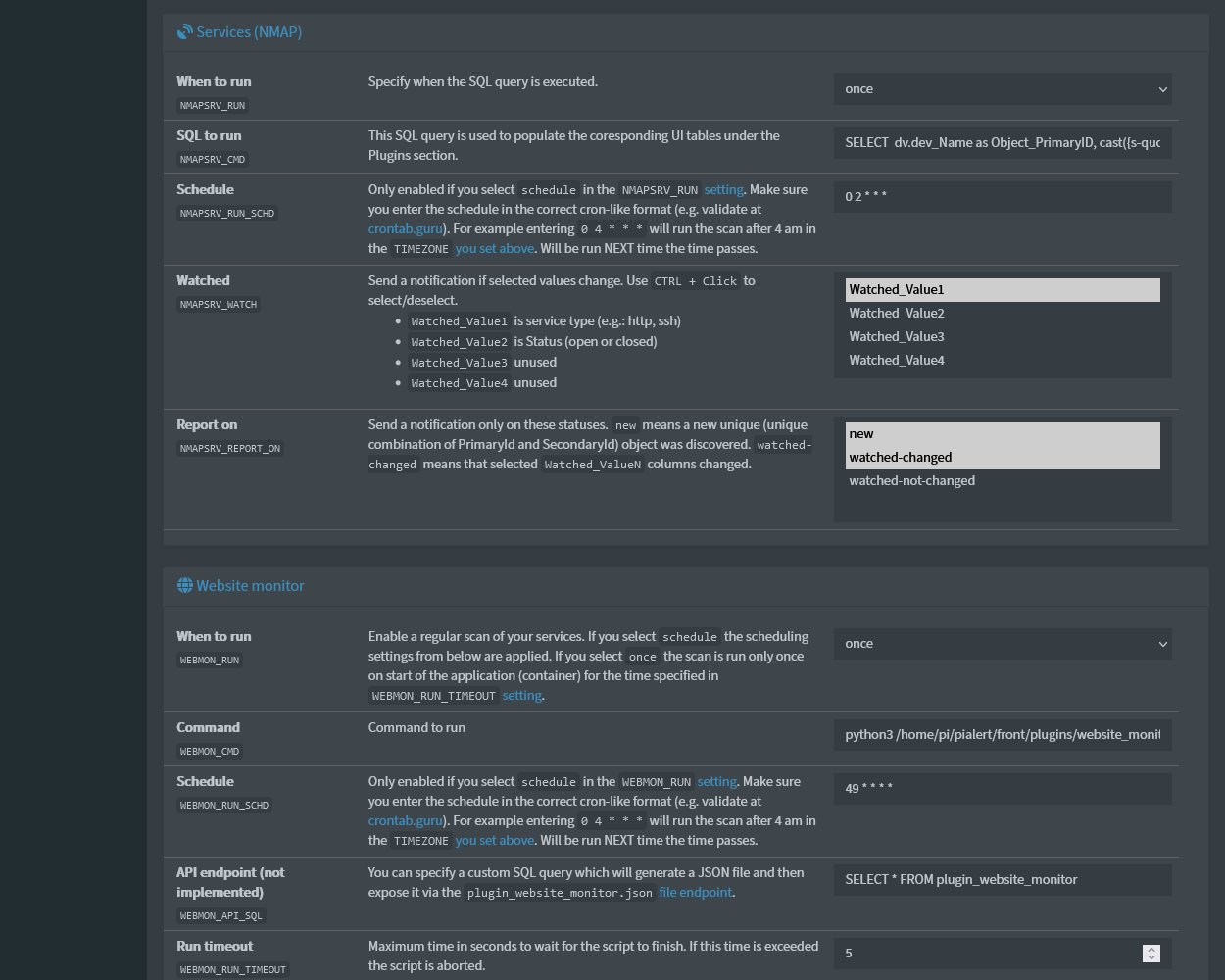 |
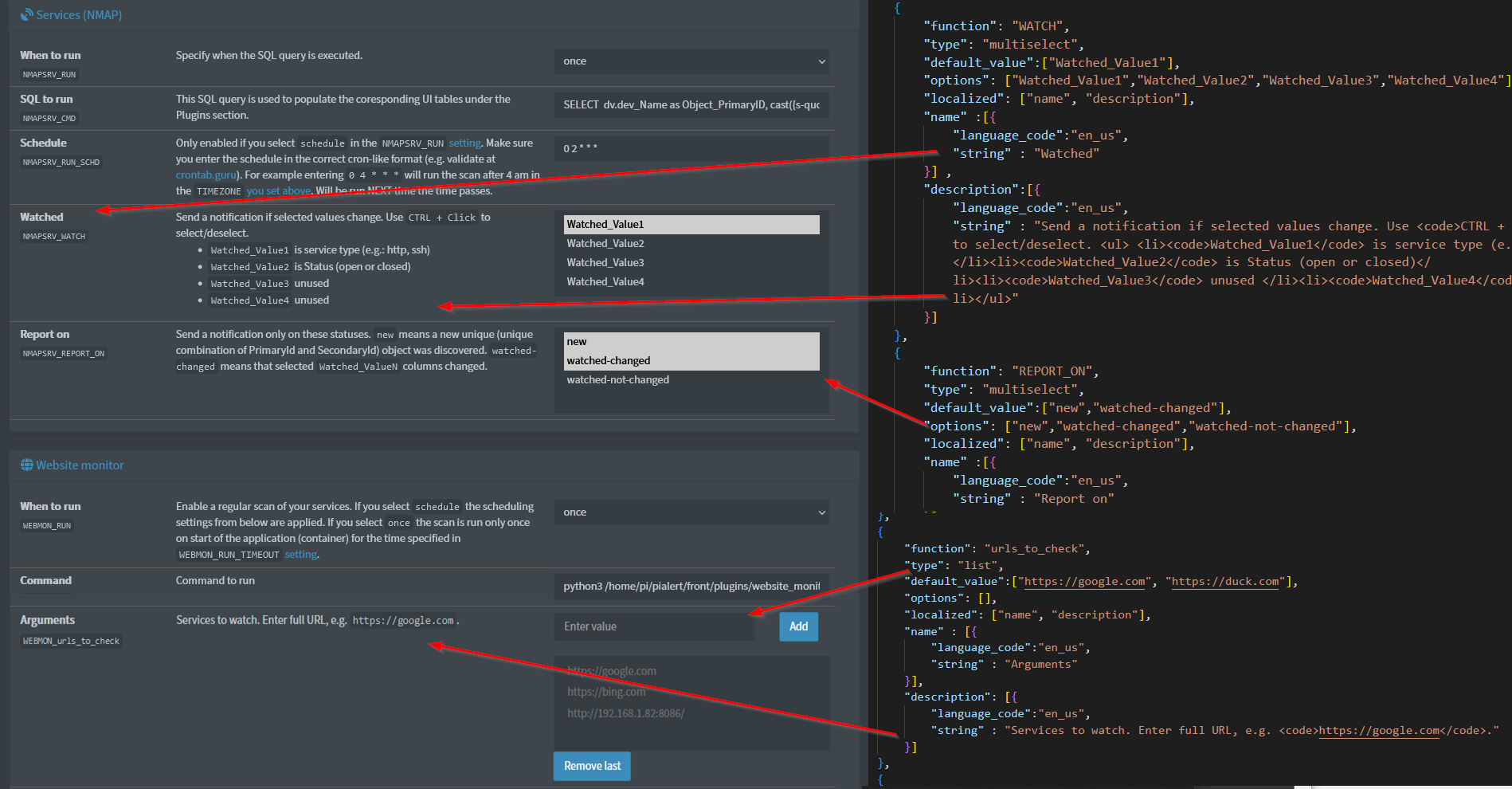 |
|---|---|---|
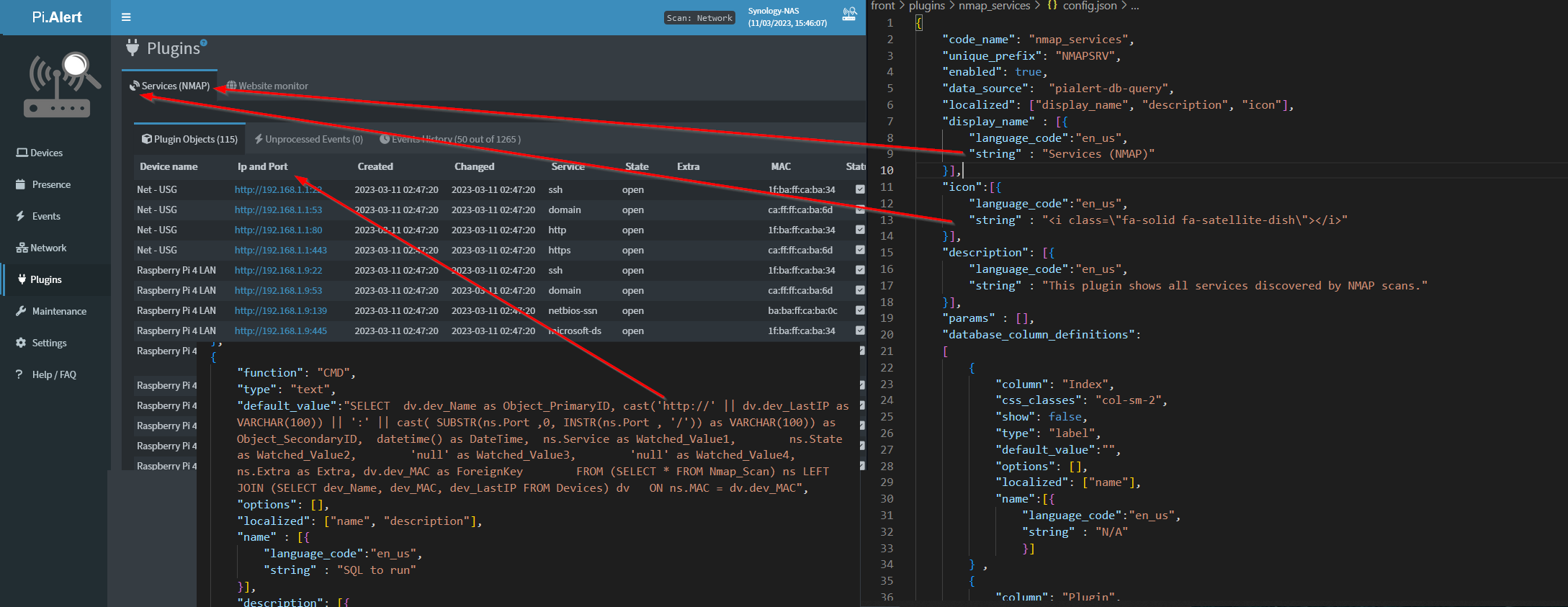 |
![Screen 5][screen5] |
PiAlert comes with a plugin system to feed events from third-party scripts into the UI and then send notifications, if desired. The highlighted core functionality this plugin system supports, is:
- dynamic creation of a simple UI to interact with the discovered objects,
- filtering of displayed values in the Devices UI
- surface settings of plugins in the UI,
- different column types for reported values to e.g. link back to a device
- import objects into existing PiAlert database tables
(Currently, update/overwriting of existing objects is not supported.)
Example use cases for plugins could be:
- Monitor a web service and alert me if it's down
- Import devices from dhcp.leases files instead/complementary to using PiHole or arp-scans
- Creating ad-hoc UI tables from existing data in the PiAlert database, e.g. to show all open ports on devices, to list devices that disconnected in the last hour, etc.
- Using other device discovery methods on the network and importing the data as new devices
- Creating a script to create FAKE devices based on user input via custom settings
- ...at this point the limitation is mostly the creativity than the capability (there might be edge cases and a need to support more form controls for user input off custom settings, but you probably get the idea)
If you wish to develop a plugin, please check the existing plugin structure. Once the settings are saved by the user they need to be removed from the pialert.conf file manually if you want to re-initialize them from the config.json of the plugin.
Again, please read the below carefully if you'd like to contribute with a plugin yourself. This documentation file might be outdated, so double-check the sample plugins as well.
⚠ Disclaimer
Follow the below very carefully and check example plugin(s) if you'd like to write one yourself. Plugin UI is not my priority right now, happy to approve PRs if you are interested in extending/improving the UI experience. Example improvements for the taking:
- Making the tables sortable/filterable
- Using the same approach to display table data as in the Devices section (solves above)
- Adding form controls supported to display the data (Currently supported ones are listed in the section "UI settings in database_column_definitions" below)
- ...
❗ Known issues:
These issues will be hopefully fixed with time, so please don't report them. Instead, if you know how, feel free to investigate and submit a PR to fix the below. Keep the PRs small as it's easier to approve them:
- Existing plugin objects sometimes not interpreted correctly and a new object is created instead, resulting in duplicate entries.
- Occasional (experienced twice) hanging of processing plugin script file. UI displays outdated values until the API endpoints get refreshed.
Plugin file structure overview
Folder name must be the same as the code name value in:
"code_name": "<value>"Unique prefix needs to be unique compared to the other settings prefixes, e.g.: the prefixAPPRISEis already in use.
| File | Required (plugin type) | Description |
|---|---|---|
config.json |
yes | Contains the plugin configuration (manifest) including the settings available to the user. |
script.py |
yes (script) | The Python script itself |
last_result.log |
yes (script) | The file used to interface between PiAlert and the plugin (script). |
script.log |
no | Logging output (recommended) |
README.md |
no | Any setup considerations or overview (recommended) |
More on specifics below.
Column order and values
| Order | Represented Column | Required | Description |
|---|---|---|---|
| 0 | Object_PrimaryID |
yes | The primary ID used to group Events under. |
| 1 | Object_SecondaryID |
no | Optional secondary ID to create a relationship beween other entities, such as a MAC address |
| 2 | DateTime |
yes | When the event occured in the format 2023-01-02 15:56:30 |
| 3 | Watched_Value1 |
yes | A value that is watched and users can receive notifications if it changed compared to the previously saved entry. For example IP address |
| 4 | Watched_Value2 |
no | As above |
| 5 | Watched_Value3 |
no | As above |
| 6 | Watched_Value4 |
no | As above |
| 7 | Extra |
no | Any other data you want to pass and display in PiAlert and the notifications |
| 8 | ForeignKey |
no | A foreign key that can be used to link to the parent object (usually a MAC address) |
config.json structure
Supported data sources
Currently, only 3 data sources are supported (valid data_source value).
- Script (
python-script) - SQL query on the PiAlert database (
pialert-db-query) - Template (
template)
🔎Example
"data_source": "pialert-db-query"
Any of the above data sources have to return a "table" of the exact structure as outlined above.
"data_source": "python-script"
If the data_source is set to python-script the CMD setting (that you specify in the settings array section in the config.json) needs to contain an executable Linux command, that generates a last_result.log file. This file needs to be stored in the same folder as the plugin.
The content of the last_result.log file needs to contain the columns as defined in the "Column order and values" section above. The order of columns can't be changed. After every scan it should contain only the results from the latest scan/execution.
- The format of the
last_result.logis acsv-like file with the pipe|as a separator. - 9 (nine) values need to be supplied, so every line needs to contain 8 pipe separators. Empty values are represented by
null. - Don't render "headers" for these "columns".
- Every scan result / event entry needs to be on a new line.
- You can find which "columns" need to be present, and if the value is required or optional, in the "Column order and values" section.
- The order of these "columns" can't be changed.
👍 Python script.py tips
The Undicoverables plugins script.py file is a good and simple example to start with if you are considering creating a custom plugin. It uses the plugin_helper.py library that significantly simplifies the creation of your custom script.
🔎 last_result.log examples
Valid CSV:
https://www.google.com|null|2023-01-02 15:56:30|200|0.7898|null|null|null|null
https://www.duckduckgo.com|192.168.0.1|2023-01-02 15:56:30|200|0.9898|null|null|Best search engine|ff:ee:ff:11:ff:11
Invalid CSV with different errors on each line:
https://www.google.com|null|2023-01-02 15:56:30|200|0.7898||null|null|null
https://www.duckduckgo.com|null|2023-01-02 15:56:30|200|0.9898|null|null|Best search engine|
|https://www.duckduckgo.com|null|2023-01-02 15:56:30|200|0.9898|null|null|Best search engine|null
null|192.168.1.1|2023-01-02 15:56:30|200|0.9898|null|null|Best search engine
https://www.duckduckgo.com|192.168.1.1|2023-01-02 15:56:30|null|0.9898|null|null|Best search engine
https://www.google.com|null|2023-01-02 15:56:30|200|0.7898|||
https://www.google.com|null|2023-01-02 15:56:30|200|0.7898|
"data_source": "pialert-db-query"
If the data_source is set to pialert-db-query the CMD setting needs to contain a SQL query rendering the columns as defined in the "Column order and values" section above. The order of columns is important.
This SQL query is executed on the pialert.db SQLite database file.
🔎Example
SQL query example:
SELECT  dv.dev_Name as Object_PrimaryID,
    cast(dv.dev_LastIP as VARCHAR(100)) || ':' || cast( SUBSTR(ns.Port ,0, INSTR(ns.Port , '/')) as VARCHAR(100)) as Object_SecondaryID,
    datetime() as DateTime,
    ns.Service as Watched_Value1,
    ns.State as Watched_Value2,
    'null' as Watched_Value3,
    'null' as Watched_Value4,
    ns.Extra as Extra,
    dv.dev_MAC as ForeignKey
FROM
    (SELECT * FROM Nmap_Scan) ns
LEFT JOIN
    (SELECT dev_Name, dev_MAC, dev_LastIP FROM Devices) dv
ON ns.MAC = dv.dev_MAC
Required
CMDsetting example with above query (you can set"type": "label"if you want it to make uneditable in the UI):{ "function": "CMD", "type": "text", "default_value":"SELECT dv.dev_Name as Object_PrimaryID, cast(dv.dev_LastIP as VARCHAR(100)) || ':' || cast( SUBSTR(ns.Port ,0, INSTR(ns.Port , '/')) as VARCHAR(100)) as Object_SecondaryID, datetime() as DateTime, ns.Service as Watched_Value1, ns.State as Watched_Value2, 'null' as Watched_Value3, 'null' as Watched_Value4, ns.Extra as Extra FROM (SELECT * FROM Nmap_Scan) ns LEFT JOIN (SELECT dev_Name, dev_MAC, dev_LastIP FROM Devices) dv ON ns.MAC = dv.dev_MAC", "options": [], "localized": ["name", "description"], "name" : [{ "language_code":"en_us", "string" : "SQL to run" }], "description": [{ "language_code":"en_us", "string" : "This SQL query is used to populate the coresponding UI tables under the Plugins section." }] }
"data_source": "template"
Used to initialize internal settings. Check the newdev_template plugin for details.
🕳 Filters
Plugin entries can be filtered based on values entered into filter fields. The txtMacFilter textbox/field contains the Mac address of the currently viewed device or simply a Mac address that's available in the mac query string.
| Property | Required | Description |
|---|---|---|
compare_column |
yes | Plugin column name that's value is used for comparison (Left side of the equation) |
compare_operator |
yes | JavaScript comparison operator |
compare_field_id |
yes | The id of a input text field containing a value is used for comparison (Right side of the equation) |
compare_js_template |
yes | JavaScript code used to convert left and right side of the equation. {value} is replaced with input values. |
compare_use_quotes |
yes | If true then the end result of the compare_js_template i swrapped in " quotes. Use to compare strings. |
🔎Example:
    "data_filters": [
        {
            "compare_column" : "Object_PrimaryID",
            "compare_operator" : "==",
            "compare_field_id": "txtMacFilter",
            "compare_js_template": "'{value}'.toString()",
            "compare_use_quotes": true
        }
    ],
- On the
pluginsCore.phppage is an input field with thetxtMacFilterid:
<input class="form-control" id="txtMacFilter" type="text" value="--">
-
This input field is initialized via the
&mac=query string. -
The app then proceeds to use this Mac value from this field and compares it to the value of the
Object_PrimaryIDdatabase field. Thecompare_operatoris==. -
Both values, from the database field
Object_PrimaryIDand from thetxtMacFilterare wrapped and evaluated with thecompare_js_template, that is'{value}.toString()'. -
compare_use_quotesis set totrueso'{value}'.toString()is wrappe dinto"quotes. -
This results in for example this code:
    // left part of teh expression coming from compare_column and right from the input field
    // notice the added quotes ()") around the left and right part of teh expression
    "eval('ac:82:ac:82:ac:82".toString()')" == "eval('ac:82:ac:82:ac:82".toString()')"
- Filters are only applied if a filter is specified and the
txtMacFilteris notundefinedor empty (--).
🗺 Mapping the plugin results into a database table
PiAlert will take the results of the plugin execution and insert these results into a database table, if a plugin contains the property "mapped_to_table" in the config.json root. The mapping of the columns is defined in the database_column_definitions array.
This approach is used to implement the DHCPLSS plugin. The script parses all supplied "dhcp.leases" files, get's the results in the generic table format outlined in the "Column order and values" section above and takes individual values and inserts them into the "DHCP_Leases" database table in the PiAlert database. All this is achieved by:
- Specifying the database table into which the results are inserted by defining
"mapped_to_table": "DHCP_Leases"in the root of theconfig.jsonfile as shown below:
{
    "code_name": "dhcp_leases",
    "unique_prefix": "DHCPLSS",
    ...
    "data_source":  "python-script",
    "localized": ["display_name", "description", "icon"],
    "mapped_to_table": "DHCP_Leases",
    ...
}
- Defining the target column with the
mapped_to_columnproperty for individual columns in thedatabase_column_definitionsarray of theconfig.jsonfile. For example in theDHCPLSSplugin, I needed to map the value of theObject_PrimaryIDcolumn returned by the plugin, to theDHCP_MACcolumn in the PiAlert databaseDHCP_Leasestable. Notice the"mapped_to_column": "DHCP_MAC"key-value pair in the sample below.
{
            "column": "Object_PrimaryID",
            "mapped_to_column": "DHCP_MAC",
            "css_classes": "col-sm-2",
            "show": true,
            "type": "devicemac",
            "default_value":"",
            "options": [],
            "localized": ["name"],
            "name":[{
                "language_code":"en_us",
                "string" : "MAC address"
                }]
        }
- That's it. PiAlert takes care of the rest. It loops thru the objects discovered by the plugin, takes the results line, by line and inserts them into the database table specified in
"mapped_to_table". The columns are translated from the generic plugin columns to the target table via the"mapped_to_column"property in the column definitions.
params
The params array in the config.json is used to enable the user to change the parameters of the executed script. For example, the user wants to monitor a specific URL.
🔎 Example: Passing user-defined settings to a command. Let's say, you want to have a script, that is called with a user-defined parameter called
urls:root@server# python3 /home/pi/pialert/front/plugins/website_monitor/script.py urls=https://google.com,https://duck.com
- You can allow the user to add URLs to a setting with the
functionproperty set to a custom name, such asurls_to_check(this is not a reserved name from the section "Supported settingsfunctionvalues" below). - You specify the parameter
urlsin theparamssection of theconfig.jsonthe following way (WEBMON_is the plugin prefix automatically added to all the settings):
{
    "params" : [
        {
            "name"  : "urls",
            "type"  : "setting",
            "value" : "WEBMON_urls_to_check"
        }]
}
- Then you use this setting as an input parameter for your command in the
CMDsetting. Noticeurls={urls}in the below json:
 {
            "function": "CMD",
            "type": "text",
            "default_value":"python3 /home/pi/pialert/front/plugins/website_monitor/script.py urls={urls}",
            "options": [],
            "localized": ["name", "description"],
            "name" : [{
                "language_code":"en_us",
                "string" : "Command"
            }],
            "description": [{
                "language_code":"en_us",
                "string" : "Command to run"
            }]
        }
During script execution, the app will take the command "python3 /home/pi/pialert/front/plugins/website_monitor/script.py urls={urls}", take the {urls} wildcard and replace it by with the value from the WEBMON_urls_to_check setting. This is because:
- The app checks the
paramsentries - It finds
"name" : "urls" - Checks the type of the
urlsparams and finds"type" : "setting" - Gets the setting name from
"value" : "WEBMON_urls_to_check"- IMPORTANT: in the
config.jsonthis setting is identified by"function":"urls_to_check", not"function":"WEBMON_urls_to_check" - You can also use a global setting, or a setting from a different plugin
- IMPORTANT: in the
- The app gets the user defined value from the setting with the code name
WEBMON_urls_to_check- let's say the setting with the code name
WEBMON_urls_to_checkcontains 2 values entered by the user: WEBMON_urls_to_check=['https://google.com','https://duck.com']
- let's say the setting with the code name
- The app takes the value from
WEBMON_urls_to_checkand replaces the{urls}wildcard in the setting where"function":"CMD", so you go from:python3 /home/pi/pialert/front/plugins/website_monitor/script.py urls={urls}- to
python3 /home/pi/pialert/front/plugins/website_monitor/script.py urls=https://google.com,https://duck.com
Below are some general additional notes, when defining params:
"name":"name_value"- is used as a wildcard replacement in theCMDsetting value by using curly brackets{name_value}. The wildcard is replaced by the result of the"value" : "param_value"and"type":"type_value"combo configuration below."type":"<sql|setting>"- is used to specify the type of the params, currently only 2 supported (sql,setting)."type":"sql"- will execute the SQL query specified in thevalueproperty. The sql query needs to return only one column. The column is flattened and separated by commas (,), e.g:SELECT dev_MAC from DEVICES->Internet,74:ac:74:ac:74:ac,44:44:74:ac:74:ac. This is then used to replace the wildcards in theCMDsetting."type":"setting"- The setting code name. A combination of the value fromunique_prefix+_+functionvalue, or otherwise the code name you can find in the Settings page under the Setting display name, e.g.SCAN_CYCLE_MINUTES.
"value" : "param_value"- Needs to contain a setting code name or SQL query without wildcards.
🔎Example:
{
    "params" : [{
            "name"  : "macs",
            "type"  : "sql",
            "value" : "SELECT dev_MAC from DEVICES"
        },
        {
            "name"  : "urls",
            "type"  : "setting",
            "value" : "WEBMON_urls_to_check"
        },
        {
            "name"  : "internet_ip",
            "type"  : "setting",
            "value" : "WEBMON_SQL_internet_ip"
        }]
}
Setting object structure
"function": "<see Supported settings function values>"- What function the setting drives or a simple unique code name"type": "<text|integer|boolean|password|readonly|integer.select|text.select|text.multiselect|list|integer.checkbox>"- The form control used for the setting displayed in the Settings page and what values are accepted."localized"- a list of properties on the current JSON level which need to be localized"name"and"description"- Displayed in the Settings page. An array of localized strings. (see Localized strings below).
Supported settings function values
You can have any "function": "my_custom_name" custom name, however, the ones listed below have a specific functionality attached to them. If you use a custom name, then the setting is mostly used as an input parameter for the params section.
RUN- (required) Specifies when the service is executed- Supported Options: "disabled", "once", "schedule" (if included then a
RUN_SCHDsetting needs to be specified), "always_after_scan", "on_new_device"
- Supported Options: "disabled", "once", "schedule" (if included then a
RUN_SCHD- (required if you include the aboveRUNfunction) Cron-like scheduling used if theRUNsetting set toscheduleCMD- (required) What command should be executed.API_SQL- (optional) Generates atable_+ code_name +.jsonfile as per API docs.RUN_TIMEOUT- (optional) Max execution time of the script. If not specified a default value of 10 seconds is used to prevent hanging.WATCH- (optional) Which database columns are watched for changes for this particular plugin. If not specified no notifications are sent.REPORT_ON- (optional) Send a notification only on these statuses. Supported options are:newmeans a new unique (unique combination of PrimaryId and SecondaryId) object was discovered.watched-changed- means that selectedWatched_ValueNcolumns changedwatched-not-changed- reports even on events where selectedWatched_ValueNdid not change
🔎 Example:
{
    "function": "RUN",
    "type": "text.select",
    "default_value":"disabled",
    "options": ["disabled", "once", "schedule", "always_after_scan", "on_new_device"],
    "localized": ["name", "description"],
    "name" :[{
        "language_code":"en_us",
        "string" : "When to run"
    }],
    "description": [{
        "language_code":"en_us",
        "string" : "Enable a regular scan of your services. If you select <code>schedule</code> the scheduling settings from below are applied. If you select <code>once</code> the scan is run only once on start of the application (container) for the time specified in <a href=\"#WEBMON_RUN_TIMEOUT\"><code>WEBMON_RUN_TIMEOUT</code> setting</a>."
    }]
}
🌍Localized strings
"language_code":"<en_us|es_es|de_de>"- code name of the language string. Only these three are currently supported. At least the"language_code":"en_us"variant has to be defined."string"- The string to be displayed in the given language.
🔎 Example:
    {
        "language_code":"en_us",
        "string" : "When to run"
    }
UI settings in database_column_definitions
The UI will adjust how columns are displayed in the UI based on the definition of the database_column_definitions object. These are the supported form controls and related functionality:
- Only columns with
"show": trueand also with at least an English translation will be shown in the UI. - Supported types:
label,text,threshold,replace,deviceip,devicemac,url. Check for details below, how columns behave based on the type.labelmakes a column display onlytextmakes a column editable and a save icon is displayed next to it.- See below for information on
threshold,replace
- The
optionsproperty is used in conjunction with these types:threshold- Theoptionsarray contains objects from lowestmaximumto highest with correspondinghexColorused for the value background color if it's less than the specifiedmaximum, but more than the previous one in theoptionsarrayreplace- Theoptionsarray contains objects with anequalsproperty, that is compared to the "value" and if the values are the same, the string inreplacementis displayed in the UI instead of the actual "value"
devicemac- The value is considered to be a Mac address and a link pointing to the device with the given Mac address is generated.deviceip- The value is considered to be an IP address and a link pointing to the device with the given IP is generated. The IP is checked against the last detected IP addresses and translated into a Mac address that is then used for the link itself.url- The value is considered to be a URL so a link is generated.
{
            "column": "Watched_Value1",
            "css_classes": "col-sm-2",
            "show": true,
            "type": "threshold",
            "default_value":"",
            "options": [
                {
                    "maximum": 199,
                    "hexColor": "#792D86"
                },
                {
                    "maximum": 299,
                    "hexColor": "#5B862D"
                },
                {
                    "maximum": 399,
                    "hexColor": "#7D862D"
                },
                {
                    "maximum": 499,
                    "hexColor": "#BF6440"
                },
                {
                    "maximum": 599,
                    "hexColor": "#D33115"
                }
            ],
            "localized": ["name"],
            "name":[{
                "language_code":"en_us",
                "string" : "Status code"
                }]
        },
        {
            "column": "Status",
            "show": true,
            "type": "replace",
            "default_value":"",
            "options": [
                {
                    "equals": "watched-not-changed",
                    "replacement": "<i class='fa-solid fa-square-check'></i>"
                },
                {
                    "equals": "watched-changed",
                    "replacement": "<i class='fa-solid fa-triangle-exclamation'></i>"
                },
                {
                    "equals": "new",
                    "replacement": "<i class='fa-solid fa-circle-plus'></i>"
                }
            ],
            "localized": ["name"],
            "name":[{
                "language_code":"en_us",
                "string" : "Status"
                }]
        }